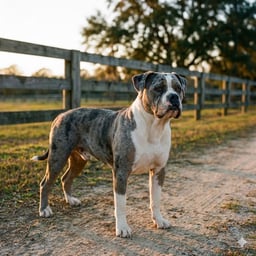
Alapaha Blue Blood Bulldog feeding guide
Complete nutrition guide with personalized feeding calculator, portion recommendations, and diet advice.
How much should a Alapaha Blue Blood Bulldog eat?
Breed research puts an adult Alapaha Blue Blood Bulldog at 1,500 to 2,300 kcal a day.
Moderate activity (1 hour daily structured walking/training); increases up to 2600 kcal for working farm catch dogs.
Meals per day: puppy 3 meals daily until 6 months of age · adult 2 equal meals daily (morning and evening)
For your own dog
At 33 kg your dog needs about 1,542 to 1,735 kcal: roughly 430 to 480 g of dry food.
Starting weight: the breed's average adult weight.
Calculated from resting energy (70 x weight^0.75) times an activity factor, and dry food at about 360 kcal per 100 g. Check the label of your food and adjust to your dog's body condition.
Per life stage
Spread over 3 to 4 meals.
Puppy food until about 6 months.
Adult phase: 2 - 8 years.
From about 8 years: fewer calories, same protein.
Puppy amounts assume about half the adult weight before 4 months and about 80% after.
Feeding a Alapaha Blue Blood Bulldog puppy
Feed an AAFCO-certified large-breed puppy formula with controlled calcium (1.0-1.4%) and phosphorus ratios to prevent rapid skeletal growth and osteochondrosis. Maintain lean body condition until growth plates close at 16-18 months.
Keeping a Alapaha Blue Blood Bulldog at a healthy weight
Prone to easy weight gain if overfed or under-exercised. The ribcage should be easily palpable under a thin layer of fat with a visible waist taper behind the ribs when viewed from above.
Deep-chested build requires splitting daily food into at least 2 meals; mandatory resting protocol (no vigorous exercise or running 60 minutes before and 90 minutes after eating); use slow feeders.
Known food sensitivities: Chicken and corn proteins (frequent triggers for allergic pruritus and ear infections), Food dye and artificial preservative sensitivities causing cutaneous flare-ups
Always wipe the deep facial folds and chin dry after each meal to prevent bacterial and fungal intertrigo.
What to watch with a Alapaha Blue Blood Bulldog
- Alapaha Blue Blood Bulldogs put on weight easily. Weigh food instead of scooping, and count training treats.
- Bloat (GDV) risk is medium: give smaller meals and no hard exercise right after eating.
- Sensitive stomach: change food gradually over a week.
- Prone to skin allergies, which are often food-related.
- Very food-motivated: easy to train with food, easy to overfeed.