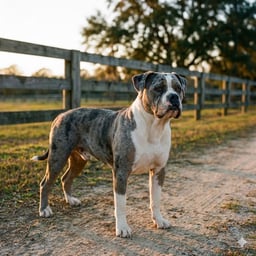
Is a Alapaha Blue Blood Bulldog right for you?
Personality traits, family compatibility, and lifestyle match - everything you need to decide.
How much exercise does a Alapaha Blue Blood Bulldog need?
85 minutes a day: about 60 minutes of physical exercise and 25 minutes of brain work.
- Walk30 minutes
Structured leash walk in the morning.
- Play30 minutes
Flirt-pole or tug session in a secure yard.
- Mental Enrichment25 minutes
Slow feeder, scent search, or chew training sessions.
Avoid midday summer jogging and high vertical drop agility impacts due to brachycephalic heat distress and ACL/hip strain.
Training a Alapaha Blue Blood Bulldog
Method that works: Positive reinforcement paired with fair, clear boundary setting and hand feeding; avoid harsh physical corrections.. Learns a new command in repetitions.
Watch out for
- Natural suspicion of strangers
- Dog intolerance and same-sex aggression
- High clamping drive and toy destruction
- Barrier frustration if subjected to harsh corrections
What works
- Focus weeks 8 to 16 on neutral exposure without direct interaction with unfamiliar dogs or strangers.
- Teach bite inhibition and a rock-solid 'Out' command early.
- Enforce mandatory hand feeding and crate calmness from day one.
Is a Alapaha Blue Blood Bulldog right for you?
Experienced bully/guardian breed owner who understands pack drive, physical containment, neutral public socialization, and fair, structured leadership.
Not a good choice as a first dog.
- Expectation of off-leash dog park freedom
- Unfenced yard or low chain-link fencing
- Chaotic household with an open-door policy for frequent guests
- Handler inability to physically manage an athletic 80-90 lb dog on leash
The first year
Fast skeletal growth up to 10 months; zero tolerance for resource guarding furniture or food from human handlers.
Typical Alapaha Blue Blood Bulldog behaviour
- The Bulldog Lean
- Pressing its full 80-pound body weight against family members' shins while being petted.
- Guttural Chortle and Huffing Snort
- Deep vocalizing when demanding evening attention or acknowledging family arrival.
- Perimeter Pacing Routine
- Making scheduled visual sweeps of fence lines upon being let outside.
- Upside-Down Sleeping Posture
- Sleeping upside-down with lips pulled back while snoring heavily.