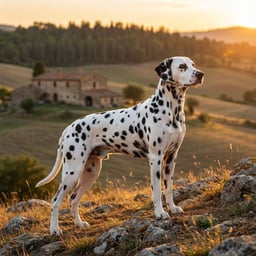

The Honest Truth
Before you fall in love, know what you're getting into.
Bred to run alongside carriages for 20-30 miles a day, Dalmatians possess an endurance engine that does not shut off. Without 90+ minutes of vigorous exercise daily, they become destructive, vocal, and neurotic.
Contrary to their friendly cartoon depiction, Dalmatians were bred to guard horses and coaches. They can be aloof with strangers, territorial of their home, and intensely attached to their owners. Separation anxiety is common and often severe.
A significant subset of Dalmatians, particularly males, develop intolerance toward other dogs of the same sex upon reaching social maturity (18-24 months).
Their short, stiff, barbed white hairs weave themselves into fabrics, upholstery, and carpets. Unlike tumbleweeds of Golden Retriever fur that can be picked up, Dalmatian hair must be individually plucked. It is relentless, shedding 365 days a year.
The Dalmatian by topic
Temperament and exercise
120 minutes a day: about 90 minutes of physical exercise and 30 minutes of brain work.
Dalmatian temperament and exerciseHealth
Hyperuricosuria (HUA) / Urolithiasis (Fixed at ~100% in traditional purebred Dalmatians; 0% in homozygous LUA (Low Uric Acid) backcross Dalmatians), Congenital Sensorineural Deafness (CSD) (17.8%–29.9% overall (13.4%–22% unilateral, 4.4%–8% bilateral depending on geographic population; UK Kennel Club 2020: 13.4% uni, 4.4% bi)), Autoimmune Lymphocytic Thyroiditis (16.3% tested abnormal or equivocal on OFA Thyroid Database)
Dalmatian health problems and testsLiving Situation
With Other Pets
Climate & Seasonal Care
No undercoat - needs coats in temps below 45F (7C). White ears and noses are prone to sunburn - use dog-safe sunscreen in summer. Ears prone to frostbite in winter.
Breed Origins
Living With a Dalmatian
- Disney Syndrome - people expect Golden Retriever temperament from the movies
- Biting puppy surrendered as aggressive at 6 months without proper training
- Under-exercised adolescent destroying furniture and home
- Unexpected medical costs from urinary stones
Life Stages
Dalmatian puppies combine high energy with a potential 'shark' biting phase. They are boisterous and can knock over children. House training is complicated by high urination frequency from required high hydration.
Peak energy age: 1-3 years
Prime years - energy stabilizes but remains active
Stone risk remains lifelong; senior monitoring is critical. Active dogs slowing down often develop arthritis.
Travel & Adventure
Bred to run with carriages - they generally love travel. Can handle 10+ miles hiking easily. Requires coat for camping in cold weather.
Safety & Containment
Bored Dalmatians will jump fences or dig under them. Invisible fences are discouraged due to their high pain tolerance and drive. Leash reactivity common if not socialized - guarding instinct turns into barrier frustration.
Breeding Information
Special Abilities
Community Insights
No Dalmatian insights yet
We're gathering data from real Dalmatian owners. Be the first to share your experience!
Register your DalmatianFeatured Dalmatians
Be the first Dalmatian creator!
No Dalmatians registered yet. Join Dogfluence and showcase your furry friend to brands.
Start creatingReal Dalmatian photos
No published Dalmatian photos yet. Be the first to add yours to the free photo library.
Care Tips for Dalmatians
Provide 90-120 minutes of vigorous daily exercise; this is a marathon runner breed that needs running, biking, or long hikes - not casual walks.
Feed a strict low-purine diet (avoid organ meats, yeast, sardines) and ensure high hydration to prevent life-threatening urate stones.
Brush frequently to manage the relentless year-round shedding; their short barbed hairs weave into fabrics and must be individually plucked from clothing.
Breed Characteristics
Dalmatian comparisons
More Dalmatian Resources
Dalmatian Costs
Calculate the true cost of ownership
Dalmatian Health
Common health issues & prevention
Dalmatian Grooming
Coat care & grooming tips
Dalmatian Food
Nutrition & diet recommendations
Dalmatian Temperament
Personality & behavior traits
Dalmatian Name Ideas
Find the perfect name for your Dalmatian
Dalmatian Hashtags
Top Instagram hashtags for Dalmatian posts
Not the Right Fit?




Frequently Asked Questions
Popular Dalmatian Mixes

Join as a Dalmatian Creator
Love your Dalmatian? Join thousands of dogfluencers and get sponsored by top pet brands!
Register my channel