For brands
Pet influencer marketing: the practical guide for 2026
Everything pet brands need to run influencer campaigns that actually convert — costs, creator selection, campaign formats, measurement, and 7 mistakes to avoid.

Dogfluence Editorial
Jun 15, 2026 · 10 min read
Pet owners buy differently. They research obsessively, trust peer recommendations over ads, and share everything — the chew their dog demolished in four minutes, the harness that finally stopped pulling, the supplement that fixed the itchy paws. That buying behavior is exactly why pet influencer marketing has become one of the highest-performing channels for brands in the category. And yet, many brands still run it like they would a lifestyle or beauty campaign — and get confused when the results look completely different.
This guide covers how pet influencer marketing actually works in 2026: what to brief, who to pick, how to measure it, and where most brands quietly leave money on the table. Whether you're running your first gifting campaign or scaling a structured creator program across dozens of collaborators, the principles are the same.
A note on platform data: the figures below draw on Dogfluence's dataset of 9,709+ registered dog influencer creators, 147,926+ analyzed social posts, and 7,172 completed product collaborations. Where we cite industry benchmarks, sources are noted inline.
Dog content draws involuntary attention — saves, shares and comments at rates other categories rarely match.
Why pet content outperforms — by a lot
The honest answer is that dogs make people stop scrolling. They're inherently watchable, they create unscripted moments, and audiences follow specific animals with the kind of loyalty more commonly associated with characters in a TV series.
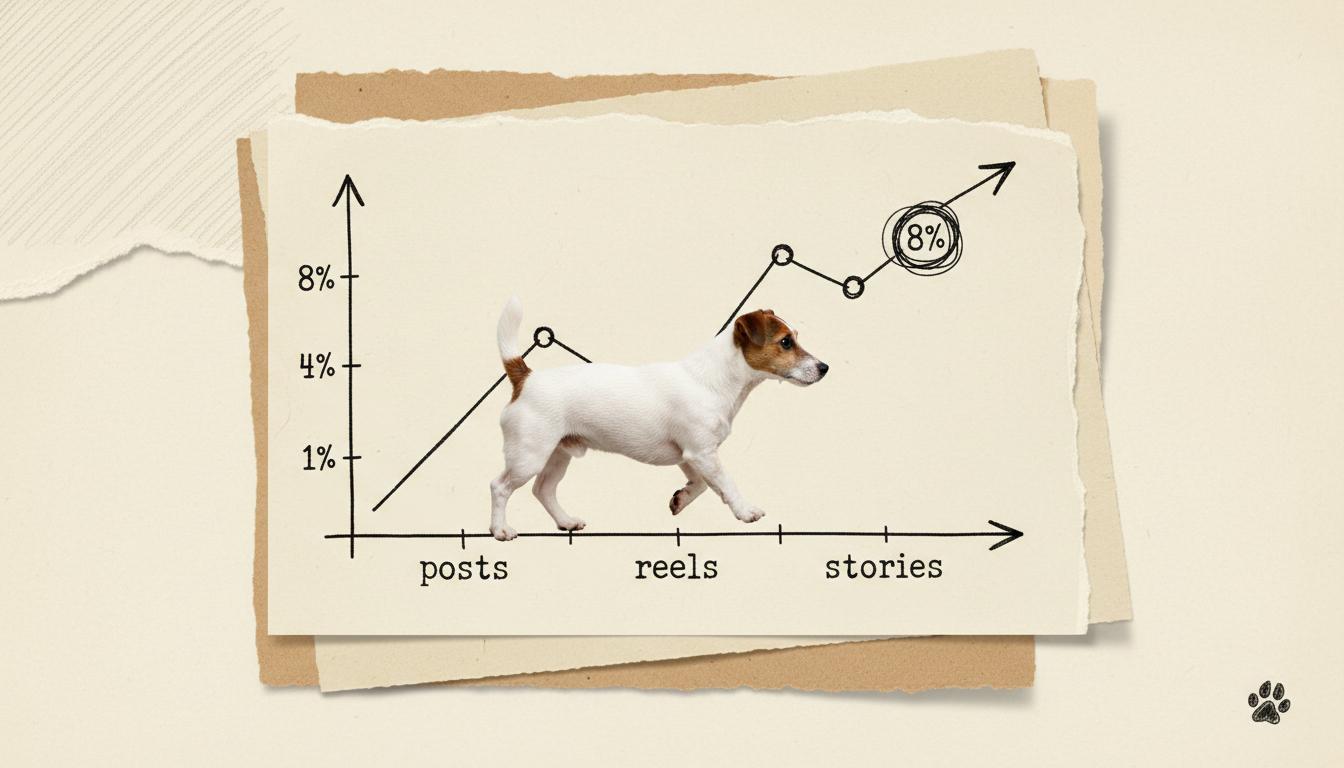
The numbers back this up. Across all analyzed posts on the Dogfluence platform, the average engagement rate is 8% — sitting two to four times above the 1–3% norm seen in most consumer categories.
This has real implications for how you evaluate creator partnerships. In pet marketing, a creator with 12,000 followers and a 9% engagement rate will typically outperform a creator with 80,000 followers posting at 1.5%. Follower count is a vanity metric here more than in almost any other space.
The pet influencer market in numbers
The market has matured significantly. Dogfluence now connects over 200 pet brands with a creator network spanning 65+ countries, and the platform has processed more than 7,172 completed product collaborations. Combined follower reach across the creator base exceeds 114 million.
Some campaign examples from the platform: BetterBone ran a campaign with 35 creators that generated 154 UGC posts and 460,000 reach. Flamingo worked with 10 creators, produced 169 posts, and hit 209,000 reach. These numbers aren't outliers — they reflect what a well-matched, brief-led campaign delivers consistently.
On cost: the rate data is more accessible than most brands expect. According to influence.co's database of 601 pet influencers, 57% of pet influencers charge $100 or less per sponsored post, and the average sits at approximately $153. Only around 3% charge over $1,000. This is a remarkably affordable channel by paid-media standards — and most of the created content can be reused as owned UGC assets.
Formats that work in 2026
Short-form video dominates. Reels and TikTok content drive the highest organic reach within the pet category, and the Collabstr 2026 Influencer Marketing Report showed UGC-style campaigns growing 133% year-over-year across influencer marketing broadly.
What "UGC-style" means in practice: candid, unpolished footage that looks like it came from the owner's camera roll rather than a studio shoot. Dogs gnawing on treats. Dogs sprinting after a ball in a branded collar. Dogs looking confused at a new toy and then immediately stealing it. This content converts because it is demonstrably real — and pet audiences are highly sensitive to inauthenticity.
Instagram Stories remain a workhorse format for a different reason: they function as delivery proof. A swipe-up or link sticker in a Story provides trackable traffic, and screenshot-based delivery verification is standard for campaign reporting. Stories disappear after 24 hours, which means brands often require story content alongside a permanent feed post — a sensible brief structure.
For brands running awareness campaigns, Reels with voiceover or on-screen text commentary from the pet owner (explaining why they chose the product) consistently outperform mute scroll-bait clips. Audio is important.
How a campaign actually runs
A well-run campaign moves through four stages:
Brief. Define what you're promoting, who your target buyer is, what you'd like the creator to communicate (one key message, not five), what formats you need, and what the posting timeline looks like. The brief is also where you specify whether you want usage rights for the content — negotiate this upfront.
Match. Finding the right creators means filtering by niche (breed community, training content, dog sport, senior dogs, etc.), engagement rate, audience geography, and brand fit. On Dogfluence, creators apply to campaigns — so you're reviewing expressions of interest from people who actively want to work with your product. That self-selection matters for content quality.
Choosing the right creator means matching format, niche and audience fit — not just engagement rate.
Deliver (the "Drop"). This is the creator submitting their content for the collaboration — posting on their channel, delivering UGC assets, or both. A structured platform gives you visibility on what's been submitted, what's pending, and what's been approved, rather than chasing DMs.
Measure. Track engagement rate per creator, total reach, link clicks or code redemptions if applicable, and the volume of reusable content generated. Post-campaign, identify your two or three highest-performing creators and consider whether a longer-term ambassador relationship makes sense.
Pet influencer rates are more accessible than most brands expect — 57% of creators charge under $100 per post.
What it actually costs
The rate data above ($153 average, 57% under $100) reflects individual posts. A campaign with, say, twelve micro-creators at an average of $120 per post runs to roughly $1,440 in fees — plus product cost and any platform subscription. That's a very different CAC calculus than paid social for most brands.
Gifting-only campaigns can work, especially for products with high perceived value (premium food, supplements, gear). The challenge is that gifting relationships come with less creative control, no guaranteed posting dates, and weaker rights to reuse the content. A hybrid — gift plus a modest fee of $50–100 — often unlocks better briefs compliance and content ownership.
For brands exploring this in detail, our dog influencer rate benchmarks guide breaks down the rate tiers with more granularity.
How to choose the right creators
Engagement rate first. For the pet category, we suggest a minimum threshold of 3% for macro-creators (100K+), 5% for mid-tier, and 6%+ for micro and nano. Below those floors, the audience isn't sufficiently active to justify the collaboration regardless of reach.
After engagement, look at niche alignment. A creator whose entire channel is about golden retrievers isn't the right fit for a cat-treat brand — but they're the obvious choice for a new golden-specific supplement. Breed, activity type (working dogs, agility, urban dogs), and audience demographics all matter.
Authenticity checks are worth fifteen minutes of due diligence: scroll the last three months of posts. Does the creator regularly sponsor products they clearly don't use? Do comments look like real engagement or templated responses? Does their audience interact with each other (replies, discussions) or just drop fire emojis? Real communities talk back.
The micro vs. macro pet influencer comparison goes deeper on this tradeoff if you're deciding where to concentrate budget.
Measurement and attribution basics
Pet influencer campaigns are not direct-response channels — don't evaluate them like Facebook ads. The right frame is upper-to-mid funnel: awareness, consideration, and UGC asset generation.
That said, some attribution is entirely achievable. Promo codes tied to individual creators give you redemption data. UTM-tagged links in Stories or bios give you click-through data. Creator-specific discount codes also serve a secondary function: they incentivize audiences to act while validating which creator communities are most commercially active.
For awareness metrics: reach and engagement rate are the primary indicators. Cost-per-engagement — total spend divided by total engagements — is a useful normalization metric for comparing campaigns across different creator tiers.
Content ROI is often undervalued. A gifting-plus-fee campaign with ten creators that generates 40 pieces of owned UGC has a content-production value that should factor into campaign economics. Repurposing creator content in paid ads, email, and product pages is standard practice and consistently outperforms brand-produced creative in A/B tests.
7 mistakes pet brands make
1. Judging creators by follower count. Already covered, but it bears repeating: a 25,000-follower account at 9% engagement reaches more active buyers than a 200,000-follower account at 0.8%.
2. Briefs that are too long. A three-page brief with mandatory hashtags, required swipe-up language, four specific product claims, and a preferred filming angle will produce stilted content. One key message and one CTA is the ceiling.
3. No usage rights agreement. If you don't negotiate rights upfront, you don't own the content — even if you paid for it. Spell out usage scope (paid ads, email, web) and duration at the brief stage.
4. Ignoring Stories. Brands focused on permanent feed posts often skip Stories entirely. Stories get high engagement from close-following audiences and provide trackable traffic. They should be part of every structured campaign brief.
5. One-off campaigns instead of ongoing relationships. The best creator-brand pairings compound over time. An ambassador who posts about your brand quarterly — genuinely, because they actually use it — is more valuable than ten one-post collaborations. Build in mechanisms to identify and retain high-performers.
6. Treating gifting as free. Product cost, shipping, packing, follow-up, and chasing late submissions all have real operational cost. Budget for it, or the economics of gifting campaigns look better on paper than they are.
7. Missing the UGC asset opportunity. The deliverable isn't just reach and impressions — it's also a library of genuine product content you can deploy across your own channels. Brands that treat influencer content as a paid-media creative source get significantly more value from the same campaigns.
Getting started: a practical checklist
Before launching a campaign, work through these:
- Set a clear objective (awareness, UGC generation, trial, or sales) — it determines the brief and measurement plan
- Define your ideal creator profile: follower range, engagement floor, niche, geography
- Decide on compensation model: gifting, gifting-plus-fee, or paid-only
- Draft a brief that fits on one page: product, one key message, required formats, posting window, CTA
- Clarify rights: what content you want to own and for how long
- Set up tracking: promo codes, UTM links, or dedicated landing page at minimum
- Define what success looks like before the campaign runs — not after
Dogfluence handles creator discovery, campaign management, delivery tracking (the "Drop" workflow), and campaign analytics in one place. With 200+ new creators joining per month and over 9,709 registered to date, it's the largest dog-specific creator network available. See how brands use it.
For creators trying to understand what brands are looking for — and what your content is worth — our guide on how much dog influencers make covers the earnings picture from the other side of the brief.
Find dog creators your customers already follow
Launch your first campaign in minutes — browse vetted dog creators, set deliverables, and only pay for real results.
Written by
Dogfluence Editorial
Editorial team
Guides and stories from the Dogfluence editorial team.